Argentina
La uruguayaArgentina is the home country from which Lucas Pereyra makes a day trip to Uruguay to collect his book advances, and the pressure of its currency controls gives that journey its practical stakes. The country is rendered not through a broad portrait of national life but through the frictions of household debt, unstable exchange rates, bank procedures, customs limits, and the hope that money might restore both domestic stability and the ability to write.
Household finances and deferred work
The trip answers a strain that has accumulated over months. Lucas connects his depression and confinement to a chain of things he says he cannot do without money: go out, send a letter, print a form, pursue work, repair the house, or clear his anger. At home, the kitchen sink has come loose and is propped up with cans; an appliance has broken, the old oven smells strange, the car’s steering wheel shakes, and a dental crown remains unfinished because it costs too much. The family has postponed an IUD, fallen behind on Maiko’s kindergarten fees and other bills, and had both bank cards rejected at Walmart, where Maiko’s tantrum unfolds beside a cart of groceries they must return.
The shortage also survives in memory as a small, humiliatingly exact scene: on a drive to visit Lucas’s brother in Pilar, the couple paid a toll with piles of fifty-cent coins, totaling fifteen pesos, and were initially told that fifty cents were missing. Lucas insisted the coins be counted again; the attendant eventually waved them through as horns sounded behind the car. The episode captures the difference between having financial problems and having no money to turn plans into action, a distinction his wife had tried to make even as their circumstances deteriorated.
Currency controls and the journey abroad
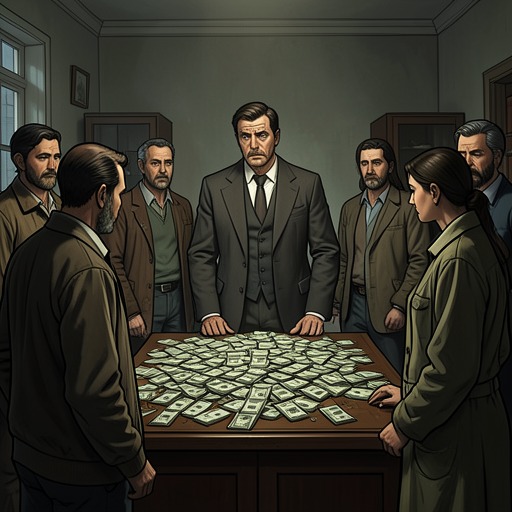
Lucas had opened an account in Montevideo in April, but the advances from book contracts signed months earlier did not arrive until September. The Spanish advance was eight thousand dollars and the Colombian one seven thousand. If transferred to Argentina, the dollars would be converted at the official rate and subject to income tax; collecting them in Uruguay and bringing them back as cash would let him exchange them in Buenos Aires at the unofficial rate, leaving him with more than twice as much. The arithmetic made the trip worthwhile, but he knew he would return with more dollars than Argentina allowed him to bring into the country.
The border crossing makes that financial arrangement tangible. At the terminal, a ticket clerk’s unusually lingering look unsettles Lucas, who wonders whether travelers making a same-day trip are being identified or listed. Immigration then checks his passport and ticket, takes his photograph, and scans his right thumbprint. Once aboard, he hears the safety announcements in Spanish, Portuguese, and English, followed by the announcement that the duty-free shop is open. The word and its promise of freedom strike him ironically: he is leaving Argentina to retrieve his own earnings and bring them back through a system whose restrictions have made the detour necessary.
The bank withdrawal is both a concrete sum and an imagined reprieve. Lucas quietly asks the teller for fifteen thousand dollars, then measures that amount against the much larger contract signed by footballer Luis Suárez on a television in the bank. In the exchange-rate confusion of the period, several different dollar values circulate, the peso is devalued, inflation continues, and the market splits between official and parallel rates. Intermediaries and informal currency dealers fill the gap. Lucas recalls an earlier attempt to exchange money in Buenos Aires in which someone followed him, smashed his car window, and tried to rob him; even the contact at the exchange house could only speculate about who had marked him. Digital transfers coexist with the need to carry printed bills across the river and conceal them from inspection.
What the money is meant to buy
Before he has the cash in hand, Lucas gives it several purposes. He wants to repay his wife for the months when the household lived on her salary, settle overdue bills, repair the home, and return money to his brother. He also imagines hiring an afternoon babysitter so he can close the door and work without interruption for nine or ten months. The advances are payment for two books: chronicles for Milenio and a novel for Astillero. The chronicles are nearly finished but still need structure; the novel remains the larger task. In his imagined version, a man leaves his wife and children, disappears into Brazil, and becomes someone else. The scheme’s grand literary energy contrasts with the practical list of debts and repairs that the money is also supposed to address.
That contrast makes the dollars more than a windfall. They represent labor already contracted, obligations to publishers and family, and a possible stretch of protected writing time. Lucas hopes that collecting them will break a cycle in which the lack of money has become an explanation for every postponed task. Yet the promised freedom depends on negotiating the very restrictions that make the money difficult to use in Argentina.
Return to Argentina
On the return to Buenos Aires, officials stop Lucas after he comes down the escalator. They search him, ask him to remove his jacket and lift his shirt, and inspect his ukulele as well as his body, looking for bundles of cash. They find nothing on him and let him pass. His immediate sense of invulnerability is sharply conditional: he has no Argentine pesos for a taxi, no car keys, and must walk more than thirty blocks from the port toward the apartment, crossing the lower tracks and climbing Córdoba Avenue. The car remains near the port until his wife retrieves it fifteen days later.
Lucas reaches home exhausted, with rib pain and a fever that leads to his hospitalization the next day. In retrospect, the return does not complete a simple escape-and-reward story. Argentina remains the place to which he must bring the money, the source of the rules that shape the crossing, and the home where the debts and stalled work still wait. The journey briefly turns those pressures into a route across the Río de la Plata; it does not, by itself, make them disappear.